
This post contains Amazon affiliate links. As an Amazon Associate I earn from qualifying purchases.
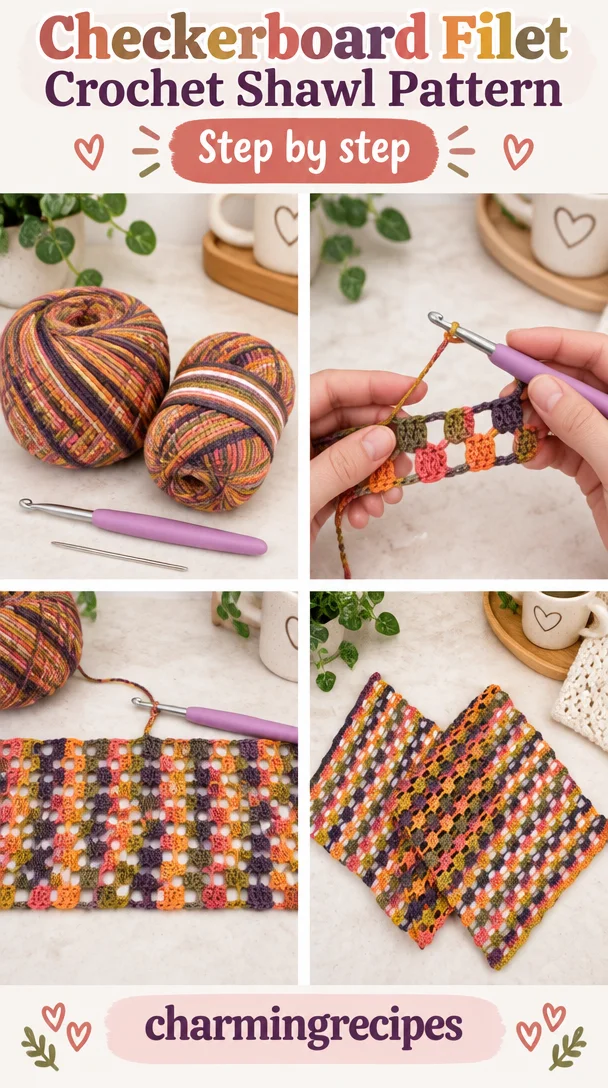
This airy filet crochet shawl uses double crochet stitches and open chain spaces to create a checkerboard-like pattern. Its repeating sections are satisfying to work once you learn how the solid blocks and mesh spaces alternate. The shawl is a good choice for crocheters who know basic stitches and want to practice keeping their rows and edges even. Make it as a light layer for cool evenings, a thoughtful handmade gift, or a relaxing project to work on a little at a time.
Why you’ll love this pattern
The checkerboard effect comes from the placement of solid groups of double crochet stitches beside open chain-4 spaces. There is no complicated colorwork or shaping to manage, so you can focus on the rhythm of the stitch pattern. After the setup rows, the repeat is easy to recognize: some rows put double crochet stitches into the spaces, while others work across the solid blocks.
Filet crochet creates a fabric with built-in openings, giving the shawl a lighter look and feel than a densely stitched wrap. It also makes a useful skill-building project. You can practice counting groups, identifying chain spaces, and keeping the turning chain consistent without learning a large set of new stitches.
The long, rectangular construction is straightforward to handle. You can work on it in sessions and check the length as you go, which makes it a relaxed project for evenings or travel. The finished shawl can be worn in several ways, and its openwork pattern makes it suitable as a light layer rather than a heavy winter wrap.
“Once I got through the setup rows, the checkerboard repeat was easy to follow. I liked watching the solid blocks and open spaces take shape, and the finished shawl feels light enough to wear over a sweater.”
Before you begin
You will make a rectangular shawl by crocheting back and forth in rows. The foundation chain sets the starting width. After the first row of double crochet, you work a sequence of mesh rows and solid-block rows to form the checkerboard filet pattern. Repeat the specified rows until the piece reaches about 59½ inches (152 cm), then work the final row to complete the upper edge.
The pattern uses chain stitches and double crochet stitches. In U.S. crochet terminology, dc means double crochet, ch means chain, sp means space, and rep means repeat. A turning chain begins a new row; in this pattern, a chain-3 or chain-7 is specified as the row starts. Pay particular attention to the chain-7 instructions, because that chain counts as one double crochet plus a chain-4 space.
This pattern is most comfortable for a crocheter who can make chains and double crochet stitches and is ready to read repeated instructions. A confident beginner can follow it carefully, but the filet sections require attention to where each group is worked. The source gives the finished length, but it does not provide a finished width, yarn quantity, or a completion time. Your width, drape, and working time will depend on your tension and the yarn you use.
Materials you’ll need
- Caron® Colorama Lacy™ yarn
- Spectral yarn
- Size U.S. J/10 (6 mm) crochet hook
- Yarn needle for finishing and weaving in the yarn end
The pattern lists both Caron® Colorama Lacy™ yarn and Spectral yarn, but does not specify quantities or how the two yarns are allocated. Check the original yarn listing or pattern source for exact yardage and color instructions before purchasing. The fiber content and care requirements can vary by yarn, so read each label.
Use the specified 6 mm hook as your starting point. If you substitute yarn, choose a yarn with a similar thickness and a compatible care label, then make a small swatch to see how the openwork drapes. A substantially thicker yarn or smaller hook can produce a denser, heavier fabric; a thinner yarn or larger hook can make the shawl more open and alter its dimensions. Because this is a filet pattern, stitch definition matters: a yarn that clearly shows the double crochet blocks and chain spaces will help the checkerboard effect stand out.
Step-by-step instructions
Work in U.S. crochet terms. The starting chain and first row establish the foundation for the mesh pattern. Turn at the end of each row where instructed, and take care to distinguish a chain-4 space from the double crochet groups around it.
-
Make the foundation chain. Chain 64.
-
Work the first row. Make 1 double crochet in the fourth chain from the hook. Make 1 double crochet in each chain to the end. Turn. You should have 62 double crochet stitches.
-
Work the second row. Chain 3. Make 1 double crochet in each of the next 4 double crochet stitches.
Repeat the following sequence: chain 4, skip the next 4 double crochet stitches, and make 1 double crochet in each of the next 4 double crochet stitches. Continue repeating until you reach the last double crochet. Make 1 double crochet in that last stitch, then turn. -
Work the third row. Chain 3. Make 1 double crochet in each of the next 4 double crochet stitches.
Repeat: chain 4, skip the next chain-4 space, and make 1 double crochet in each of the next 4 double crochet stitches. Continue repeating to the last double crochet. Make 1 double crochet in the last stitch. Turn. -
Work the fourth row. Chain 7; this counts as 1 double crochet and a chain-4 space. Skip the next 4 double crochet stitches.
Repeat: make 4 double crochet stitches in the next chain-4 space, chain 4, and skip the next 4 double crochet stitches. Continue repeating to the last double crochet. Make 1 double crochet in the last stitch, then turn. -
Work the fifth row. Chain 7; this counts as 1 double crochet and a chain-4 space. Skip the next chain-4 space.
Repeat: make 1 double crochet in each of the next 4 double crochet stitches, chain 4, and skip the next chain-4 space. Continue repeating to the last double crochet. Make 1 double crochet in the last stitch, then turn. -
Work the sixth row. Chain 3. Make 4 double crochet stitches in the next chain-4 space.
Repeat: chain 4, skip the next 4 double crochet stitches, and make 4 double crochet stitches in the next chain-4 space. Continue repeating to the last double crochet. Make 1 double crochet in the last stitch, then turn. -
Repeat the pattern rows. Repeat rows 3 through 6 until the shawl measures about 59½ inches (152 cm). End after completing a fifth row as described in the pattern. Measure along the work without stretching the open mesh.
-
Work the final row. After ending on a fifth row, chain 3.
Repeat: make 4 double crochet stitches in the next chain-4 space, then make 1 double crochet in each of the next 4 double crochet stitches. Continue repeating to the last chain-4 space. Make 4 double crochet stitches in that last space, then make 1 double crochet in the last double crochet stitch. -
Finish. Fasten off. Thread the yarn end onto the yarn needle and weave it securely into the fabric without pulling the openwork out of shape.
Reading the repeats and keeping the pattern straight
Rows 2 through 6 establish how the checkerboard sections are formed. In some rows, the chain-4 spaces create open mesh; in others, groups of 4 double crochet fill the spaces and create solid blocks. Keep track of the row number as you work, especially after the repeat begins, because rows 3 through 6 do not all end with the same turning instruction in the supplied directions.
The pattern says to repeat rows 3 to 6 until the piece measures the target length, ending on a fifth row. Follow that ending condition as well as the measurement. If you are unsure which row you have just completed, mark the first stitch of a repeat or keep a simple row tally on paper. Before beginning the final row, check that you have ended on row 5.
The first row’s count of 62 double crochet stitches is a helpful check. In later rows, the fabric includes chain spaces, so do not count each opening as a double crochet. Instead, look for the four-stitch groups and the spaces between them. Consistent counting helps prevent a missed group from shifting the checkerboard alignment.
Ways to use your finished project
Wear the shawl loosely over your shoulders as a light wrap, or fold it lengthwise and drape it around your neck as a scarf. The open filet fabric works well over a solid top, where the pattern is easy to see without competing with other textures. For a more relaxed look, let the ends hang evenly; for extra warmth around the shoulders, bring one end across the front.
This crochet shawl also makes a thoughtful gift for someone who enjoys handmade accessories. Choose colors that suit the recipient’s wardrobe, and include a small note about the yarn’s care instructions if you know them. Since the source does not give yarn quantities, confirm the amount needed before planning a gift in a particular yarn or color.
If you sell handmade accessories, the long rectangular shape can be easy to display folded or draped on a mannequin. Before listing or selling items made from the pattern, check the original designer’s usage terms. Do not assume that publication of a pattern automatically grants permission for commercial use.
How to care for your crochet project
Caron® Colorama Lacy™ and Spectral yarn may have different fiber contents or care requirements. Check the labels for both yarns before washing the finished shawl, and follow the instructions for the more delicate yarn. If the fiber content or care method is uncertain, gentle hand washing is the safer option.
Use cool or lukewarm water and a mild detergent suitable for the yarn. Avoid vigorous rubbing, twisting, or wringing, which can distort the open chain spaces and stretch the shawl. Rinse gently if the label calls for it, then press out excess water between clean towels.
Reshape the shawl while it is damp and lay it flat to dry on a clean surface. Smooth the edges and align the checkerboard blocks without pulling the fabric wider than its natural shape. Blocking can help even out the openwork, but use a method appropriate for the yarn’s fiber; do not apply heat or steam unless the label indicates it is safe.
Store the shawl clean and completely dry. Fold it loosely rather than hanging it for long periods, as the weight of the fabric can stretch the openwork. Keep it away from rough surfaces, snagging jewelry, and strong colors that could transfer dye while damp.
Tips for success
- Keep the chain spaces consistent. Make each chain-4 space with a similar tension. If some spaces are much tighter than others, the filet pattern may pull unevenly.
- Count the first row. The foundation row should have 62 double crochet stitches. Checking this early is easier than trying to correct a width problem several rows later.
- Track the row repeat. Rows 3 through 6 form the repeating sequence, and row 5 is the required ending point before the final row. Use a row counter or tally marks so you do not lose your place.
- Identify the spaces before stitching into them. The chain-4 space is the open loop made by the previous row’s chain. Work the specified group of 4 double crochet stitches into that space, rather than into one of the chain stitches individually.
- Watch the edge stitches. The instructions repeatedly finish with a double crochet in the last stitch. Missing that edge stitch can make the shawl narrow gradually; adding an extra stitch can make the edge flare.
- Check the turning chain. The chain-7 in rows 4 and 5 counts as a double crochet plus a chain-4 space. Treat it as both parts of the pattern, not as seven separate stitches.
- Measure without stretching. Lay the shawl flat and measure its length in a relaxed state. The chain spaces can lengthen when pulled, so stretching during measurement may lead you to stop too early.
- Make a small test swatch if changing yarn. A swatch helps you assess how clearly the solid blocks show and whether the fabric has the light drape you want. A different yarn or hook may change the width and the amount of yarn required.
- Use a gentle finish. Weave in the end along the back of a solid double crochet section where possible. Secure it without drawing the openwork tight.
If the edges start to look uneven, pause and compare the last few rows. Check whether the final double crochet was made into the last stitch and whether the turning chain was handled as directed. Correcting a missed edge stitch near where it happens is usually easier than trying to disguise a slanted edge at the end.
Creative variations
Change the color palette. Use shades that create a clear contrast between the solid blocks and open spaces, or choose a single color for a quiet, tonal look. If the pattern source calls for both Caron® Colorama Lacy™ and Spectral yarn, confirm how those yarns are intended to be used before changing their color placement. Switching colors can add yarn ends, so plan how you will secure them neatly.
Adjust the length. The pattern specifies a length of approximately 59½ inches (152 cm). To make the shawl shorter or longer, repeat the pattern section fewer or more times, while still ending on a fifth row before working the final row. A longer shawl requires more yarn and more working time; a shorter one uses less. The width is mainly established by the foundation chain, so changing the width may require recalculating the stitch groups and spaces rather than simply adding an arbitrary number of chains.
Try a different yarn cautiously. A yarn of similar thickness may work, but changes in fiber, weight, or twist can affect drape, stitch definition, finished size, and yardage. A fuzzy or highly textured yarn may hide the checkerboard effect. Make a swatch with the 6 mm hook before committing to the full project.
Add a simple edging. A narrow border could give the sides a more finished outline, but the source pattern does not include an edging. Any added border will change the final appearance and may draw in or stretch the openwork if worked too tightly. Test it on a small section or keep the edging loose and lightweight.

Frequently asked questions
Is this filet crochet shawl suitable for beginners?
It can suit a confident beginner who already knows how to chain and double crochet. The stitches are basic, but the repeated groups and chain spaces require careful counting. Practice reading the row sequence and checking the edge stitches before working several repeats.
What yarn works best for this pattern?
The listed materials are Caron® Colorama Lacy™ yarn and Spectral yarn. The pattern does not provide yarn quantities or explain how much of each yarn to use, so check the original source for those details. If substituting, choose a yarn with clear stitch definition and a similar thickness, then swatch to check the openwork and drape.
Can I use a different crochet hook?
The pattern specifies a U.S. J/10 (6 mm) hook. You can test a different size if your yarn or personal tension calls for it, but changing the hook can affect the shawl’s width, length, openness, and yarn use. Make a swatch first and compare the fabric with the airy filet texture you want.
How long does it take to crochet?
The pattern does not provide an estimated completion time. The time will depend on your pace, how often you work on it, and whether you are familiar with the row repeat. Once you can recognize the solid blocks and chain-4 spaces, the repeated section should be more straightforward than the setup rows.
How do I make the shawl longer or shorter?
Repeat rows 3 through 6 more or fewer times, then finish with the final row after ending on a fifth row. Keep the measurement relaxed and check the length as you go. A longer shawl will use more yarn; the source gives a target length of about 59½ inches (152 cm).
How can I make the shawl wider?
The width is set by the foundation chain of 64, which produces 62 double crochet stitches in the first row. Increasing or decreasing the starting chain may disrupt the four-stitch groups and chain-space repeat. If you want a different width, plan the stitch multiples carefully and make a swatch rather than adding chains without adjusting the repeat.
Why is my shawl curling or pulling at the edges?
Uneven tension, missed edge stitches, or inconsistent turning chains can make the sides pull in or flare out. Check that each row ends with the specified double crochet in the last stitch and that the chain-7 is treated as a double crochet plus a chain-4 space. Lay the work flat periodically to spot changes early. Gentle blocking may help even out minor tension differences if the yarn label permits it.
How should I wash the finished shawl?
Follow the care label for both listed yarns, as their fiber contents may differ. When unsure, hand wash gently in cool or lukewarm water, avoid wringing, and lay the shawl flat to dry after reshaping it. Avoid hanging it while wet, since the open fabric may stretch.
How much yarn do I need?
The supplied instructions do not state the yarn quantity or yardage. Check the original pattern source or yarn listing for the exact amount of Caron® Colorama Lacy™ and Spectral yarn required. Do not rely on an estimate if you need to match a particular dye lot or complete the full-length shawl.
Can I sell a shawl made from this pattern?
The instructions provided here do not state whether finished items may be sold. Check the original designer’s usage terms before selling or listing a shawl made from the pattern.
Print
Airy Filet Crochet Shawl
Description
This airy filet crochet shawl uses double crochet stitches and open chain spaces to create a checkerboard-like pattern. It is perfect for crocheters who know basic stitches and want to practice keeping their rows and edges even.
Materials
- Caron® Colorama Lacy™ yarn
- Spectral yarn
- Size U.S. J/10 (6 mm) crochet hook
- Yarn needle for finishing and weaving in the yarn end
Instructions
- Make the foundation chain. Chain 64.
- Work the first row. Make 1 double crochet in the fourth chain from the hook. Make 1 double crochet in each chain to the end. Turn. You should have 62 double crochet stitches.
- Work the second row. Chain 3. Make 1 double crochet in each of the next 4 double crochet stitches. Repeat the following sequence: chain 4, skip the next 4 double crochet stitches, and make 1 double crochet in each of the next 4 double crochet stitches. Continue repeating until you reach the last double crochet. Make 1 double crochet in that last stitch, then turn.
- Work the third row. Chain 3. Make 1 double crochet in each of the next 4 double crochet stitches. Repeat: chain 4, skip the next chain-4 space, and make 1 double crochet in each of the next 4 double crochet stitches. Continue repeating to the last double crochet. Make 1 double crochet in the last stitch. Turn.
- Work the fourth row. Chain 7; this counts as 1 double crochet and a chain-4 space. Skip the next 4 double crochet stitches. Repeat: make 4 double crochet stitches in the next chain-4 space, chain 4, and skip the next 4 double crochet stitches. Continue repeating to the last double crochet. Make 1 double crochet in the last stitch, then turn.
- Work the fifth row. Chain 7; this counts as 1 double crochet and a chain-4 space. Skip the next chain-4 space. Repeat: make 1 double crochet in each of the next 4 double crochet stitches, chain 4, and skip the next chain-4 space. Continue repeating to the last double crochet. Make 1 double crochet in the last stitch, then turn.
- Work the sixth row. Chain 3. Make 4 double crochet stitches in the next chain-4 space. Repeat: chain 4, skip the next 4 double crochet stitches, and make 4 double crochet stitches in the next chain-4 space. Continue repeating to the last double crochet. Make 1 double crochet in the last stitch, then turn.
- Repeat rows 3 through 6 until the shawl measures about 59½ inches (152 cm). End after completing a fifth row as described in the pattern. Measure along the work without stretching the open mesh.
- Work the final row. After ending on a fifth row, chain 3. Repeat: make 4 double crochet stitches in the next chain-4 space, then make 1 double crochet in each of the next 4 double crochet stitches. Continue repeating to the last chain-4 space. Make 4 double crochet stitches in that last space, then make 1 double crochet in the last double crochet stitch.
- Finish. Fasten off. Thread the yarn end onto the yarn needle and weave it securely into the fabric without pulling the openwork out of shape.