

This post contains Amazon affiliate links. As an Amazon Associate I earn from qualifying purchases.
The Timeless Tunisian Crochet Blanket combines a broad center panel with narrower color panels, picot details, and a finished border. Its repeated Tunisian simple stitch rows create a steady rhythm, while the changing colors and small decorative accents keep the project interesting. It suits crocheters who are comfortable learning or practicing Tunisian crochet and want to make a cozy, useful blanket for the home or as a thoughtful handmade gift.
Why you’ll love this pattern
This blanket is a satisfying way to explore Tunisian crochet beyond a simple swatch. The center panel gives you room to practice Tunisian simple stitch, also called Tss, and the repeating picot sequence adds a decorative detail without requiring a complicated textured stitch pattern.
The construction is worked in panels, so you can focus on one section at a time instead of managing the full blanket width on your hook. Working the panels separately can also make color changes easier to organize. Once the panels are ready, you join their long edges and add the finishing edging.
The pattern is especially appealing if you enjoy projects that balance repetition with small milestones. You can check your progress as each section takes shape, and the color arrangement gives the finished blanket a coordinated, handcrafted look. It is a good choice for a relaxing at-home project, though the growing panels may be less portable than a small Tunisian crochet accessory.
“I enjoyed the steady rhythm of the Tunisian stitches, and the picots gave the panels a lovely little detail. Joining the pieces was a satisfying final step—the blanket really came together once the edging was on.”
How this crochet pattern comes together
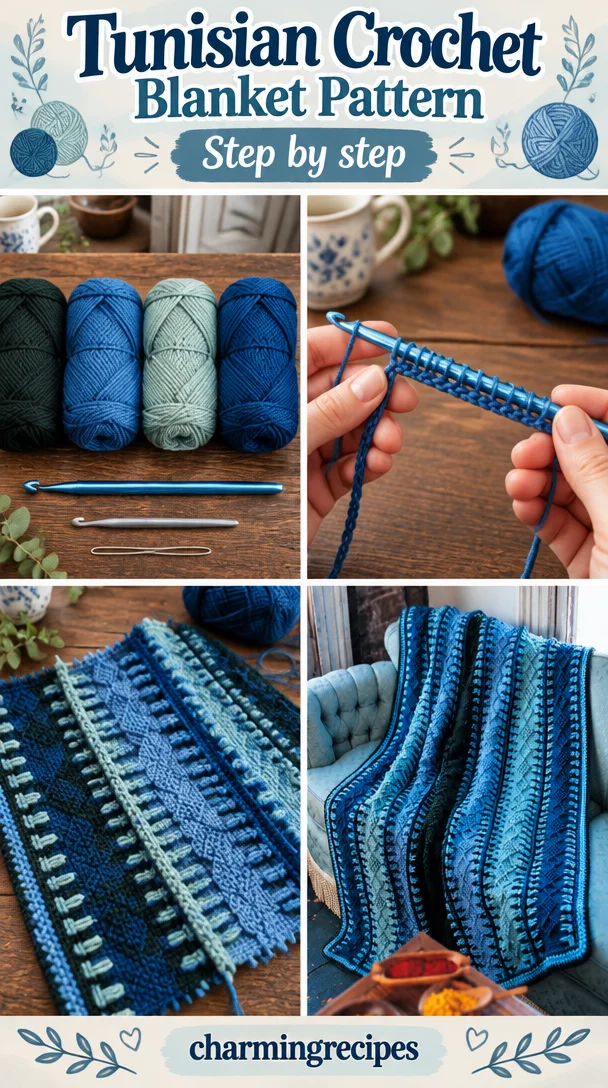
You will make one wide center panel and six narrow panels: two panels in each of three additional colors. The instructions identify the colors as A, B, C, and D. The listed yarn shades are Dark Sage, Country Blue, Light Sage, and Windsor Blue; assign each shade to a letter before beginning and keep that key nearby.
The main stitch is Tunisian simple stitch. Unlike ordinary crochet rows, Tunisian crochet uses a forward pass to pick up loops along the row and a return pass to work them off the hook. The loops from the forward pass remain on the hook until the return pass is complete. The pattern also uses chain-3 loops to form picots, then joins the finished panels with slip stitches before working the edging.
The source instructions refer to charts A through D and to panel-border and edging instructions, but those chart details and stitch-by-stitch finishing instructions are not included here. You will need the original charts or complete pattern directions to reproduce those portions accurately. The written steps below retain the provided stitch counts and sequence without guessing at missing chart symbols or border details.
This project is best suited to an adventurous beginner who already understands basic crochet terms, or an intermediate crocheter learning Tunisian crochet. The repeated rows make the central stitch approachable, but managing the loops on a Tunisian hook and reading the referenced charts require attention. The total time will vary with your Tunisian crochet experience, hook handling, and pace; allow for multiple panels, joining, and edging rather than treating it as a quick one-sitting project.
Materials you’ll need
- Red Heart® Super Saver® yarn in the four listed colors: Dark Sage, Country Blue, Light Sage, and Windsor Blue. These are the shades to use for colors A, B, C, and D; confirm the color-to-letter assignment from the original chart or pattern before starting.
- Size U.S. G/6 (4 mm) Tunisian/Afghan hook for the panels.
- Size G/6 (4 mm) crochet hook for finishing steps that call for a regular crochet hook.
- Yarn needle for weaving in the ends.
The pattern does not provide a yarn quantity, gauge, or finished measurements in the supplied instructions. Check the complete original pattern for those details before buying yarn, especially if you are substituting a different yarn. A different weight or fiber can change the blanket’s size, drape, warmth, and yarn requirements. If you choose another yarn, make a Tunisian crochet swatch and compare it with the original pattern’s gauge, when available.
Step-by-step instructions
Before you begin
Read the referenced charts and confirm the order of colors A, B, C, and D. The written information specifies the center panel’s opening rows and repeat sequence, but later rows depend on charts A through D. It also refers to panel-border and edging instructions without providing their stitch details. Do not guess those sections: use the complete chart and finishing directions from the original pattern.
In these instructions, ch means chain, yo means yarn over, lp means loop, sl st means slip stitch, and Tss means Tunisian simple stitch. A forward pass picks up loops along the row; a return pass works those loops off the hook.
1. Make the center panel
With color A and the Tunisian/Afghan hook, chain 40.
- First row, forward pass: Insert the hook into the second chain from the hook. Yarn over and draw up a loop. Insert the hook into the next chain, yarn over, and draw up a loop. Repeat across the chain. You should have 40 loops on the hook.
- First row, return pass: Work the Tunisian simple stitch return pass. The row ends with 40 Tunisian simple stitches.
- Rows 2–5: Work a Tunisian simple stitch forward pass and return pass on each row.
- Row 6, forward pass: Work the Tunisian simple stitch forward pass. You should have 40 loops on the hook.
- Row 6, return pass: Yarn over and draw through one loop on the hook. Then yarn over and draw through two loops 19 times. Chain 3 to create a loop for a picot on the next forward pass. Yarn over and draw through two loops 20 times. This makes 39 Tunisian simple stitches and one Tunisian simple stitch with a picot.
- Row 7, forward pass: Work the Tunisian simple stitch forward pass, holding the chain-3 loop toward the front so it forms a picot. You should again have 40 loops on the hook.
- Row 7, return pass: Yarn over and draw through one loop on the hook. Yarn over and draw through two loops 18 times. Chain 3 for a picot. Yarn over and draw through two loops twice, then chain 3 for a second picot. Finish by yarning over and drawing through two loops 19 times. This makes 38 Tunisian simple stitches and two Tunisian simple stitches with picots.
2. Follow the center-panel chart
Continue working the Tunisian simple stitch forward pass as before. Starting with the eighth chart row for the return pass, follow charts A through D in order. Continue until you complete the return pass of row 23.
Repeat rows 6–23 12 more times. Then work rows 6–14 once, followed by row 2 five more times. The chart determines the details of the rows not fully written out here, so follow its symbols and color instructions carefully.
3. Finish the center panel
For the last row, skip the first vertical bar. Slip stitch into the next vertical bar and into each vertical bar across. Fasten off.
4. Make the narrow panels
Make two panels in each of colors B, C, and D, for six narrow panels total.
For each panel, use the appropriate color and the Tunisian/Afghan hook. Chain 20. Follow the same general panel instructions as for the center panel, using this shorter starting chain. The supplied directions do not include the narrow panels’ full chart or row-by-row stitch details, so use the original chart and complete panel instructions for those rows.
5. Add the panel borders
Work across the long edge of each panel, repeating the original panel-border instructions for all panels. The stitch sequence for this border is not included in the supplied text; follow the complete pattern directions rather than substituting an improvised border.
6. Join the panels
Lay out the panels in the order specified by the original pattern. Keep the lower edge of every panel at the same end, and place the right sides facing each other. Using slip stitches, join the panels along their long edges. Check the orientation before joining each seam so the panel ends remain aligned.
The exact left-to-right color order is not stated in the provided instructions. Refer to the original layout or chart to confirm the sequence before seaming.
7. Work the edging
Work the specified edging rounds using colors D, C, B, and A, in that order. The round-by-round stitch instructions are not included here, so use the original pattern’s edging directions for the correct stitch count, corners, and color changes.
8. Finish
Fasten off as directed and use the yarn needle to weave in all ends securely. For a neater finish, weave each end through the backs of several stitches, change direction, and trim only after the end feels secure. Avoid pulling the yarn so tightly that the joined seams or blanket edge pucker.
Ways to use your finished project
The most natural use for this project is as a sofa or reading-chair blanket. Tunisian crochet can produce a substantial fabric, making a finished blanket useful for curling up with at home. Check the fabric’s weight and drape as you work; a dense Tunisian fabric may feel warmer and heavier than a looser crochet blanket.
It can also make a meaningful handmade gift for a housewarming, wedding, birthday, or winter holiday. The four-color palette can be chosen to suit the recipient’s home, provided you keep the pattern’s color assignments and panel layout clear while working.
For a neat display, fold the blanket over the back of a couch or drape it across the foot of a bed. If you plan to give it as a gift, include a simple care note based on the yarn-label instructions so the recipient knows how to wash and dry it safely.
How to care for your crochet project
Red Heart® Super Saver® is an acrylic yarn, but always check the care label on the specific skeins you use. Follow the label’s instructions for washing and drying. If you substitute another fiber, its care needs may differ.
- Wash gently: Use the care method recommended on the yarn label. A cool or warm wash and mild detergent are sensible choices when permitted by the label.
- Protect the blanket: Avoid rough washing that could strain the panel seams or cause excessive pilling. If machine washing is allowed, a gentle cycle and a suitable laundry bag can reduce friction, though a full blanket may not fit comfortably in every machine.
- Dry with support: Follow the label’s drying directions. If the blanket is heavy when wet, support its full weight when moving it so the panels and seams do not stretch.
- Reshape carefully: Smooth the blanket into shape on a clean, flat surface if needed. Do not stretch the edges to force the blanket to a particular size.
- Store clean and dry: Fold the blanket and keep it in a dry, well-ventilated place. Avoid long-term storage while damp, which can lead to musty odors.
- Watch color transfer: For the first wash, wash separately or with similar colors, especially if the yarn shades are dark or strongly saturated. This is a cautious step when combining several colors in one project.
Helpful crochet tips
- Keep a color key: Write down which listed shade is A, B, C, and D before you cast on. The instructions use letter labels, and mixing them up can make the final panel arrangement confusing.
- Count the loops on the first row: The center panel should have 40 loops on the hook after its first forward pass. The narrow panels begin with a chain of 20. Check these starting counts before moving into the repeat.
- Use a row tracker: The center-panel sequence includes chart rows through 23, then a long repeat. Mark off each completed repeat on paper or in a row-counting app. It is easy to lose your place when rows 6–23 repeat many times.
- Understand the two Tunisian passes: Do not begin a new forward pass while loops from the previous row remain on the hook. Work the return pass fully, following the pattern’s picot instructions, before continuing.
- Take care with picots: The chain-3 loops are intentional. Keep them toward the front where instructed on the next forward pass so they sit as visible decorative points instead of disappearing into the fabric.
- Check the fabric as you go: Tunisian crochet can curl, particularly near the beginning of a piece. Keep the work relaxed and avoid tightening the edge stitches. A border may help stabilize the finished blanket, but use the pattern’s specified border rather than adding one before you know how it affects the size.
- Align panel ends before seaming: Lay all panels flat and check that their lower edges are at the same end before joining. This small check can prevent an uneven or reversed panel arrangement.
- Use the correct finishing directions: The instructions refer to a chart, panel borders, and edging rounds that are not included in the supplied text. Find the complete directions before reaching those steps so you do not have to unpick a guessed finish.
Customize your project
- Choose a different palette: The four listed shades create a coordinated multicolor look. You can select other colors in a similar yarn, but keep the A–D key and the original panel order. Changing the palette affects appearance, not the construction.
- Plan a seasonal version: Warm rust, cream, and deep green can suit an autumn or winter look; lighter shades can give the blanket a brighter feel. Keep strong contrasts in mind so the panel pattern remains easy to see.
- Make a size adjustment cautiously: Changing the center chain, narrow-panel chain, number of panels, or repeat count can alter the blanket’s proportions. The supplied instructions do not give gauge or finished measurements, so do not assume that adding stitches will create a predictable size increase. Work a swatch and consult the complete pattern’s sizing guidance before modifying the panel dimensions.
- Test a yarn substitution: A different yarn weight or fiber can change the blanket’s size, density, warmth, and drape. Make a swatch with the Tunisian hook and compare it with the pattern gauge, if available, before committing to all seven panels.
- Coordinate with the room: Choose colors that echo a sofa, rug, or bedding, then use the four-color edging sequence from the original instructions for a cohesive finish. Adding a new decorative edging or appliqués may change the weight or look of the border; test any extra trim on a small sample first.
Frequently asked questions
Is this Tunisian crochet blanket suitable for beginners?
It can suit an adventurous beginner who knows basic crochet and is ready to learn Tunisian crochet. The forward pass, return pass, chart reading, repeated row sequence, and picots require careful tracking. Practice Tunisian simple stitch on a small swatch before beginning the blanket if you are new to the technique.
What yarn should I use for this pattern?
The listed yarn is Red Heart® Super Saver® in Dark Sage, Country Blue, Light Sage, and Windsor Blue. Use the complete pattern’s color key to assign those shades to colors A–D. If you choose another yarn, check its label and make a Tunisian crochet swatch; a different weight or fiber can change the blanket’s size, texture, and drape.
Can I use a different hook size?
The pattern lists a U.S. G/6 (4 mm) Tunisian/Afghan hook for the panels and a regular G/6 (4 mm) crochet hook for the specified finishing work. A different hook can make your stitches tighter or looser and change the finished dimensions. If your fabric does not match the pattern gauge, follow the complete pattern’s gauge guidance before changing hook size.
How many panels do I need to make?
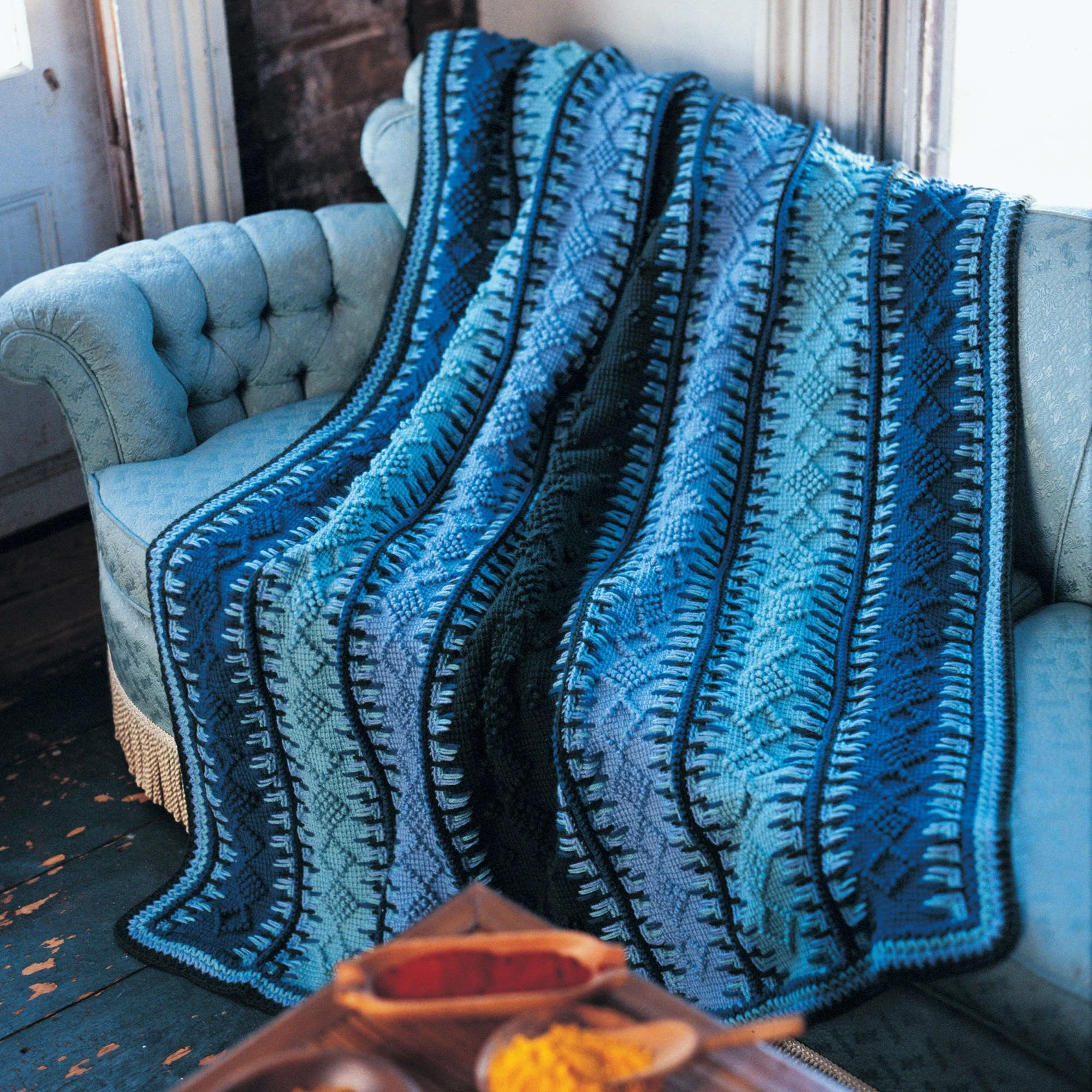
The instructions call for one center panel and two narrow panels in each of colors B, C, and D. That makes six narrow panels, seven panels total. The exact finished layout and color order should be checked against the original chart or pattern image.
How do I keep the Tunisian crochet edges even?
Keep your yarn tension relaxed and make the edge stitches carefully, since tight edge loops can make a panel narrower or curl more. Count the loops on the first row and compare panel edges as you work. If you use stitch markers, place them at consistent edge points to help you recognize where each row begins and ends.
Why is my Tunisian crochet panel curling?
Some curling can occur in Tunisian crochet, especially at the starting edge. Tight tension may make it more noticeable. Work evenly and avoid pulling the first or last stitches too tightly. Use the border specified by the pattern, and follow its blocking or finishing guidance if provided. Do not add an untested border that may change the panel size.
How can I make the blanket larger or smaller?
The provided instructions do not include a gauge or finished measurements, so a reliable size adjustment cannot be calculated from the supplied details alone. Changing chain lengths, panel counts, or repeat counts can affect the proportions and the amount of yarn needed. Check the complete pattern’s sizing information and make a swatch before changing the construction.
How much yarn do I need?
The supplied material list does not state yardage or skein quantities. Check the complete original pattern for the amount needed in each color before purchasing yarn. If using a substitute yarn, estimate only after comparing its gauge and yardage with the original yarn, and consider having extra yarn available for joining and finishing.
How should I wash the finished blanket?
Follow the care label on the yarn you used. For Red Heart® Super Saver®, check the current label for the specific washing and drying directions. Use gentle handling, avoid stretching the blanket while it is wet, and reshape it flat if needed.
Can I sell blankets made from this pattern?
The instructions provided do not state the designer’s terms for selling finished items. Check the original designer’s usage terms or pattern license before selling a blanket made from this design.
Print
Timeless Tunisian Crochet Blanket
Description
The Timeless Tunisian Crochet Blanket combines a broad center panel with narrower color panels, picot details, and a finished border. It is a cozy, useful blanket for home or a thoughtful handmade gift.
Materials
- Red Heart® Super Saver® yarn in Dark Sage
- Red Heart® Super Saver® yarn in Country Blue
- Red Heart® Super Saver® yarn in Light Sage
- Red Heart® Super Saver® yarn in Windsor Blue
- Size U.S. G/6 (4 mm) Tunisian/Afghan hook
- Size G/6 (4 mm) crochet hook
- Yarn needle
Instructions
- Make the center panel: With color A and the Tunisian/Afghan hook, chain 40. Work forward pass and return pass for each row as instructed.
- Continue with the center-panel chart and follow rows 6–23, repeating as specified.
- Finish the center panel with the slip stitch as directed.
- Make six narrow panels in colors B, C, and D: Use the appropriate color, chain 20, and follow the same general instructions for each panel.
- Add the panel borders according to the specified instructions.
- Join the panels using slip stitches, ensuring the orientation is correct.
- Work the specified edging rounds as instructed.
- Finish by fastening off and weaving in all ends.
Notes
Refer to the complete original pattern for details regarding charts, specific stitch counts, and seam finishing.