
This post contains Amazon affiliate links. As an Amazon Associate I earn from qualifying purchases.
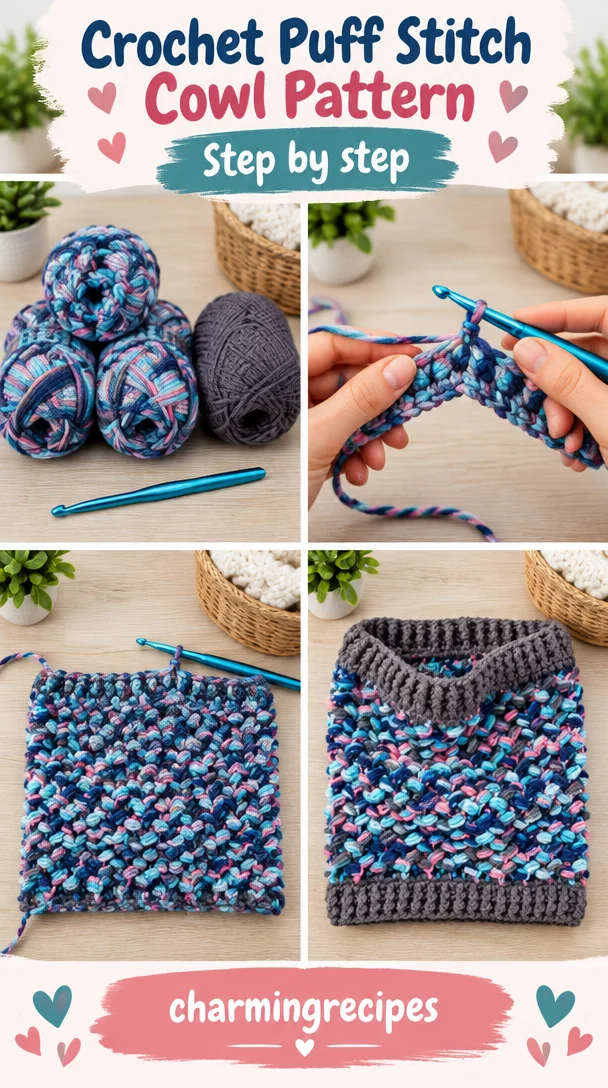
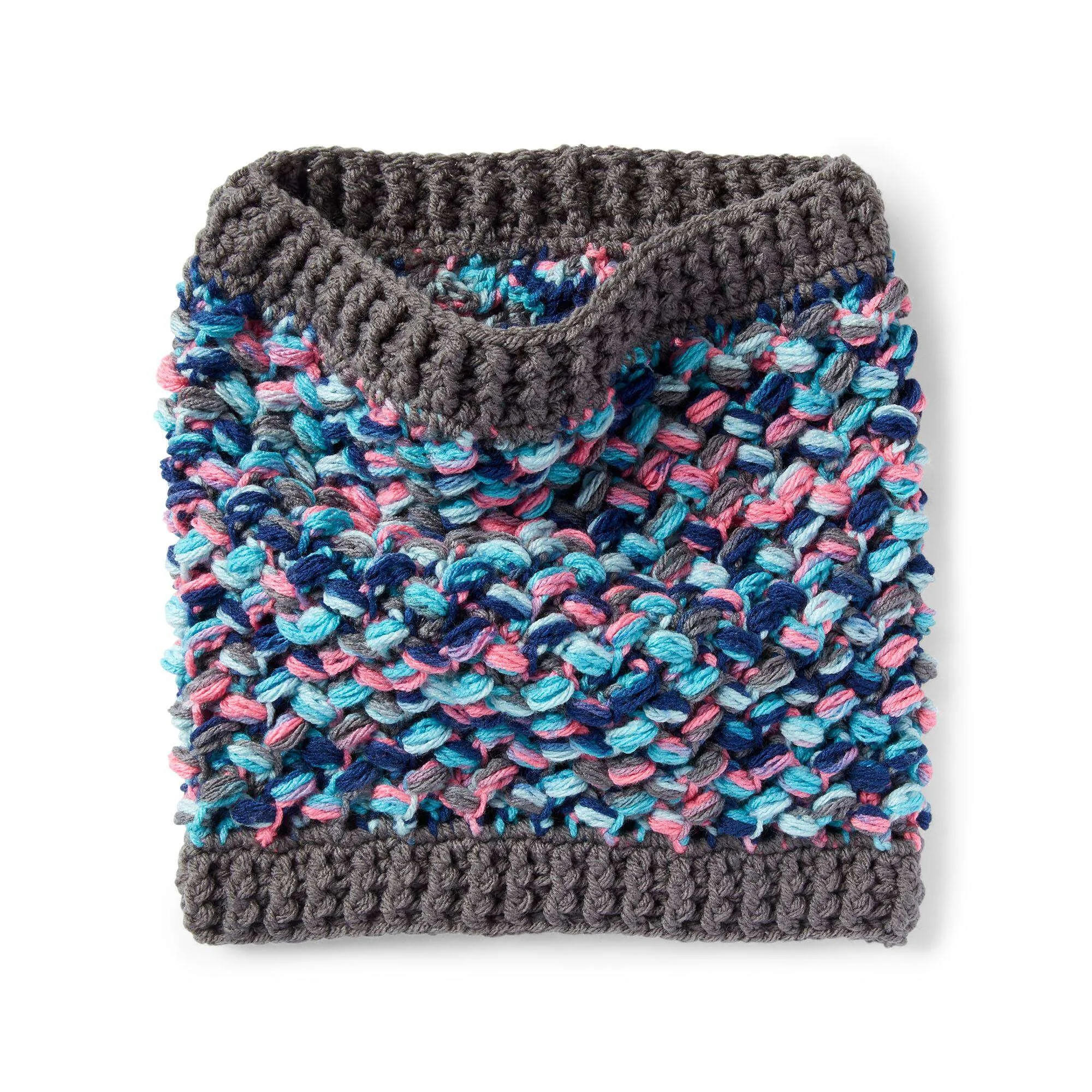
A soft, textured crochet cowl is a satisfying project when you want a wearable accessory that feels special without requiring complicated shaping. This puff stitch crochet cowl is worked as a long rectangle, then joined at the seam, with a contrasting ribbed border added at the top and bottom. The repeating puff-and-double-crochet pattern gives the fabric plenty of visual interest, making it a lovely choice for confident beginners and experienced crocheters alike.
Why you’ll love this pattern
The puff stitches create a raised, cushioned texture that makes this cowl feel warm and substantial. A simple two-row repeat keeps the main fabric manageable once you understand how the stitches fit together. You can also see the pattern develop clearly as you work, which makes this a useful project for practicing puff stitches and front-post and back-post double crochet.
The cowl’s construction is practical: crochet a rectangle to the specified length, seam it, and add two matching rounds of ribbed edging. The contrasting trim gives the finished piece a neat frame and helps the edges sit comfortably. Since the main fabric uses a repeated stitch pattern rather than complicated shaping, it can also make pleasant, portable crochet for quiet evenings or travel.
The finished cowl makes a thoughtful handmade gift for someone who enjoys cozy accessories. The puff texture and contrast edging give it a polished appearance without requiring separate motifs or elaborate finishing.
“I enjoyed settling into the two-row repeat after the first row clicked. The raised puffs look lovely, and the contrasting ribbed edges make the cowl feel nicely finished.”
Before you begin
You’ll make a rectangular piece in Contrast A, using a starting chain of 37 and repeating the second and third rows until the fabric measures 24 in (61 cm) from the beginning. The rectangle is fastened off, then joined at its seam to form a cowl. Contrast B is used for the top and bottom borders.
The main technique is the puff stitch, paired with double crochet stitches that are worked around it in a particular order. The placement may feel unusual at first: some of the double crochets are worked into stitches to the right and left of the puff, and the work is directed either behind or in front of the puff depending on the row. Read the first row carefully and use the row instructions as written; the placement creates the intended texture.
The ribbed edges use front-post double crochet and back-post double crochet. These stitches wrap around the posts of stitches from the previous round, rather than going through their top loops. The alternating posts create the raised vertical ribs.
This is best suited to a crocheter who is comfortable with chain stitches and double crochet, or a beginner who is happy to take the first few rows slowly. The pattern does not give a completion time; your pace will depend on your experience, stitch speed, and how often you pause to check the puff placement.
Materials you’ll need
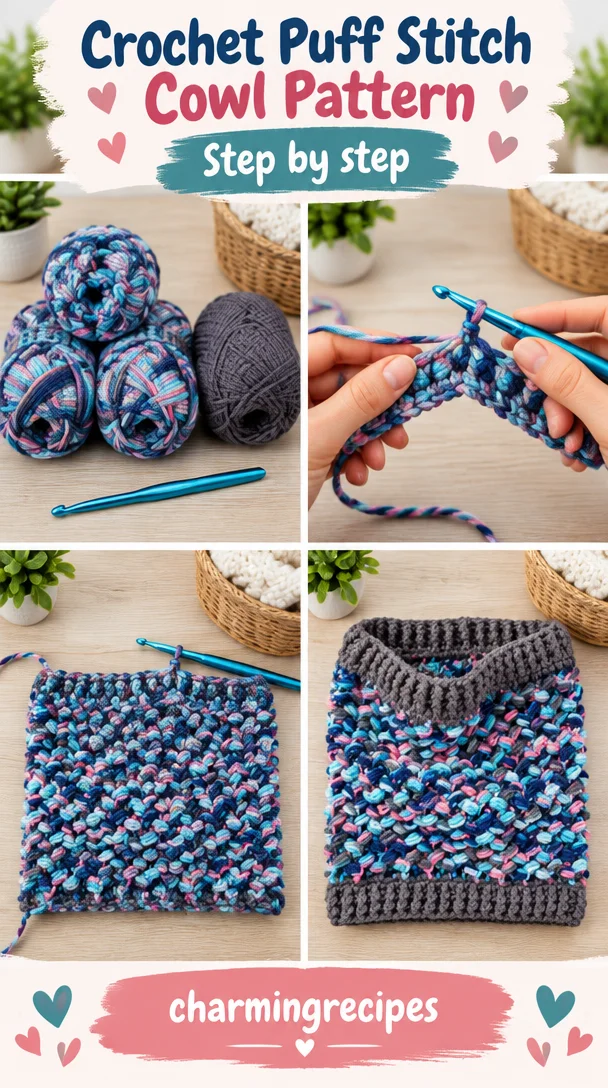
- Contrast A: RedHeart™ Heat Wave™ Prints, 3.5 oz/100 g, 164 yds/150 m per ball — 3 balls
- Contrast B: RedHeart™ Heat Wave™, color Radio (0420), 3.5 oz/100 g, 198 yds/181 m per ball — 1 ball
- Crochet hook: U.S. H/8 (5 mm), or the size needed to obtain gauge
The yarn information provided does not specify fiber content or a yarn-weight category, so check the ball bands for those details and care instructions. If you substitute yarn, choose one with a similar weight and texture and make a gauge swatch if gauge information is available with your pattern. A different yarn or hook can change the cowl’s finished size, thickness, drape, and yardage needs. A very smooth yarn makes the puff stitches easier to see, while a highly textured or fuzzy yarn may soften their definition.
Step-by-step instructions
Abbreviations and stitch notes
- ch: chain
- dc: double crochet
- sc: single crochet
- sl st: slip stitch
- RS / WS: right side / wrong side
- Pu st: puff stitch
- dcfp: double crochet worked around the post from the front
- dcbp: double crochet worked around the post from the back
- Rep: repeat
- Beg: beginning
The source instructions refer to a puff stitch but do not give a separate stitch-by-stitch formula for making one. If you are unfamiliar with the pattern’s puff stitch, check the original pattern’s stitch definition before starting. Use the same puff-stitch method consistently throughout the cowl.
Make the cowl body
-
Start the foundation chain. With Contrast A, chain 37.
-
Work the first row on the right side. Make a puff stitch in the sixth chain from the hook. The five skipped chains count as one double crochet and two chains.
-
Place the first pair of double crochets. Working behind the puff stitch you just made, work one double crochet into the second chain to the right of that puff. Work one double crochet into the next chain to the left of the last double crochet.
-
Continue across the chain. Skip the last puff stitch and the next two chains. Make a puff stitch in the next chain. Working behind this new puff stitch, work one double crochet into the second chain to its right, then one double crochet into the next chain to the left of that double crochet. Repeat this sequence from the asterisk until you reach the last chain.
-
Finish the first row. Work one double crochet into the last chain. The row has 35 stitches. Turn.
-
Work the second row. Chain 3; this counts as one double crochet. Skip the next two double crochets. Make a puff stitch in the next puff stitch. Working in front of the puff stitch you just made, work one double crochet into the second double crochet to its right, then one double crochet into the next double crochet to the left of that double crochet.
-
Repeat across the row. Repeat the sequence from the asterisk until you reach the last double crochet. Work one double crochet into the last double crochet. Turn.
-
Work the third row. Chain 3; this counts as one double crochet. Skip the next two double crochets. Make a puff stitch in the next puff stitch. Working behind the puff stitch you just made, work one double crochet into the second double crochet to its right, then one double crochet into the next double crochet to the left of that double crochet.
-
Repeat and finish the row. Repeat the sequence from the asterisk until you reach the last double crochet. Work one double crochet into the last double crochet. Turn.
-
Continue the body pattern. Repeat the second and third rows, alternating them, until the work measures 24 in (61 cm) from the beginning. End on a wrong-side row. Fasten off.
Add the top edging
-
Join Contrast B. With the right side of the cowl facing you and beginning at the seam, join Contrast B with a slip stitch at the top of the cowl.
-
Work the first round. Chain 1. Work 78 single crochets evenly around the top edge. Join with a slip stitch to the first single crochet.
-
Work the second round. Chain 3; this counts as one double crochet. Work one double crochet into each single crochet around. Join with a slip stitch to the top of the beginning chain-3.
-
Work the third round. Chain 2; this does not count as a stitch. Work one front-post double crochet around the first double crochet. Work one back-post double crochet around the next double crochet. Repeat this alternating sequence around the round. Join with a slip stitch to the first stitch.
-
Work the fourth round. Chain 2; this does not count as a stitch. Work one front-post double crochet around the first front-post double crochet. Work one back-post double crochet around the next back-post double crochet. Repeat this alternating sequence around the round. Join with a slip stitch to the first stitch. Fasten off.
Add the bottom edging
- Repeat the edging for the bottom. Work the same four edging rounds around the bottom edge of the cowl: 78 single crochets evenly around, a round of double crochet, then two rounds alternating front-post and back-post double crochet. Fasten off.
Weave in the ends securely, taking care not to pull the fabric out of shape. Check that the two edging rounds sit evenly before wearing or gifting the cowl.
Styling ideas for your finished cowl
Wear the cowl over a sweater, coat, or jacket when you want a warm layer without the loose ends of a scarf. Its loop shape is also convenient for commuting and outdoor walks, since it is less likely to trail or slip off your shoulders than a long scarf.
The raised puff stitches give the piece enough texture to stand out over a plain outfit. For everyday wear, pair it with a solid-colored coat so the stitch pattern and contrast ribbing are easy to see. If you make the cowl as a gift, choose colors that suit the recipient’s wardrobe, or coordinate the trim with a favorite hat or mittens.
It can also be a useful handmade item for a winter craft fair or an online shop, provided you follow the pattern designer’s terms for finished-item sales. Before listing it, photograph the texture and edging clearly, and describe the yarn and care details accurately.
How to care for your crochet project
Check both yarn ball bands before washing; follow the care instructions for the yarn used in your finished cowl. The exact fiber content is not specified here, so avoid assuming that every yarn substitution can be treated the same way.
If the label allows machine washing, use the recommended cycle and water temperature. A mesh laundry bag can help reduce friction and snagging. Otherwise, hand wash gently in cool or lukewarm water with a mild detergent. Avoid twisting or wringing the cowl, because that can stretch the fabric and distort the puff stitches.
Press out excess water between clean towels, then reshape the cowl and dry it flat. Avoid hanging it while wet, as the weight of the fabric may lengthen it. Use blocking only if the yarn label and fiber type allow it; aggressive blocking can flatten the raised puff texture. Once fully dry, store the cowl clean and dry, folded loosely rather than stretched on a hanger.
If your Contrast A and Contrast B colors are dark or saturated, take extra care during the first wash. Follow the label, and avoid leaving the damp cowl folded against light-colored clothing or fabric.
Tips for a successful cowl
- Learn the stitch placement before settling into the repeat. The double crochets around each puff are worked in a specific order. Pause after the first repeat to confirm that the puff and its two double crochets are positioned as intended.
- Keep the two body rows distinct. The second row directs you to work the double crochets in front of the puff; the third row directs you to work them behind it. Losing track of the row can change the fabric’s texture. A row counter or a small note beside your work can help.
- Count the first row. It should have 35 stitches. If your count differs, check the skipped chains and the final double crochet before continuing.
- Use a marker for the edge stitch if needed. The chain-3 at the beginning of the second and third rows counts as a double crochet. Marking it can help you find the last stitch when you reach the end of the row.
- Measure the rectangle as you go. Stop when it measures 24 in (61 cm) from the beginning and make sure the final row is a wrong-side row, as specified. Avoid stretching the fabric while measuring.
- Distribute the edging stitches evenly. The pattern calls for 78 single crochets around each edge. Space them as evenly as possible so the border lies flat and does not ruffle or pull inward.
- Keep track of the post stitches. In the ribbing, alternate front-post and back-post double crochet around the round, then place each stitch around its matching post on the next round. This preserves the raised rib pattern.
- Check the seam area while edging. Beginning each edging round at the seam helps you keep the join discreet and makes it easier to compare the top and bottom borders.
- Weave in ends without puckering. Secure each end through several stitches on the wrong side, but do not pull so tightly that the cowl fabric gathers.
Creative ways to customize it
Choose a different color story. The pattern’s contrasting border is an easy place to personalize the cowl. Try a bold trim against a neutral body, two closely related shades for a subtle finish, or seasonal colors for a winter gift. Keep the yarns similar in weight and texture so the edging does not behave differently from the body.
Adjust the rectangle length cautiously. The pattern specifies a body length of 24 in (61 cm). Making the rectangle longer will create a larger loop; making it shorter will produce a closer-fitting cowl. The resulting circumference and fit change with the length, and a longer piece will use more yarn. The pattern does not provide a finished circumference or an alternate size chart, so check the fit carefully before fastening off.
Change the fabric width only if you are prepared to adjust the stitch setup. The original foundation chain and stitch placement are designed together. Simply adding chains may not maintain the same puff-stitch repeat or the stated stitch count. A wider cowl can require a reworked foundation and more yarn, so swatch and confirm the repeat before making the full piece.
Try a different yarn texture with care. A similar-weight yarn may work, but a very bulky, lightweight, fuzzy, or loosely spun yarn can change the drape and make the puff stitches look quite different. It may also affect the 78-stitch edging, which is specified for this pattern. Swatch first and be prepared to adjust how evenly you distribute the edging stitches.
Coordinate accessories. Use the same colors for a matching hat or wrist warmers, or repeat the contrasting ribbing on a simple coordinating accessory. This cowl itself has a clear puff texture, so a simpler companion piece can balance the set.
Frequently asked questions
Is this puff stitch crochet cowl suitable for beginners?
It can suit a confident beginner who knows chain stitches and double crochet and is willing to follow the unusual puff placement carefully. The two-row repeat is manageable once established, but the first row and the front/behind placement may take practice. If you are new to puff stitches, try a small swatch first.
What yarn and hook does the pattern call for?
The pattern specifies RedHeart™ Heat Wave™ Prints for Contrast A, three balls, and RedHeart™ Heat Wave™ in Radio (0420) for Contrast B, one ball. Both are listed as 3.5 oz/100 g, with the yardage given for each. Use a U.S. H/8 (5 mm) crochet hook, or the size needed to obtain gauge.
How much yarn do I need?
The listed amount is three balls of Contrast A, at 164 yds/150 m per ball, and one ball of Contrast B, at 198 yds/181 m per ball. The pattern does not give a separate total-y yardage estimate beyond those ball quantities. If you substitute yarn, buy enough from the same dye lot where possible, especially for the main color.
Can I use a different hook size?
Yes, but changing hook size affects the fabric. A larger hook generally makes looser, larger stitches; a smaller hook generally makes denser fabric. The pattern says to use a 5 mm hook or the size needed to obtain gauge. Swatch with your chosen yarn and hook, and consider how the change affects the cowl’s drape and finished measurements.
How do I make the cowl larger or smaller?
The pattern’s body length is 24 in (61 cm). A longer rectangle makes a larger loop, while a shorter one makes a smaller loop. Keep in mind that the pattern does not supply alternate measurements, and changing the foundation width can disrupt the stitch sequence. Measure the fabric without stretching it and check the fit before fastening off.
Why is my cowl edging wavy or pulling in?
The 78 single crochets around each edge need to be spaced evenly. Too many stitches can make the edge ruffle; too few can draw it inward. Check that you have distributed the stitches consistently around the full opening. Also confirm that your yarn and hook are not creating a significantly different fabric from the one intended.
How do I keep the body edges even?
Treat the beginning chain-3 on rows two and three as a double crochet, and remember to work the final double crochet into the last stitch. A stitch marker in the first or last stitch can make the row boundaries easier to identify. Count the first row to confirm the stated 35 stitches, and check the edges every few rows.
How should I wash the finished cowl?
Use the care instructions on the yarn labels, since the fiber content and washing requirements depend on the yarn. When uncertain, gentle hand washing in cool or lukewarm water is a cautious option. Press out water in a towel and dry flat rather than hanging the cowl while wet.
Can I sell cowls made from this pattern?
The supplied pattern information does not state whether finished items may be sold. Check the original designer’s usage terms before selling the cowl, and follow any requirements for credit or other restrictions.
Print
Puff Stitch Crochet Cowl
Description
A soft, textured crochet cowl that feels warm and substantial, perfect for confident beginners and experienced crocheters. This cowl is made by working a long rectangle, then joining it at the seam, with contrasting ribbed borders added.
Materials
- Contrast A: RedHeart™ Heat Wave™ Prints, 3.5 oz/100 g, 164 yds/150 m per ball — 3 balls
- Contrast B: RedHeart™ Heat Wave™, color Radio (0420), 3.5 oz/100 g, 198 yds/181 m per ball — 1 ball
- Crochet hook: U.S. H/8 (5 mm), or the size needed to obtain gauge
Instructions
- Start the foundation chain. With Contrast A, chain 37.
- Work the first row on the right side. Make a puff stitch in the sixth chain from the hook. The five skipped chains count as one double crochet and two chains.
- Place the first pair of double crochets. Working behind the puff stitch you just made, work one double crochet into the second chain to the right of that puff. Work one double crochet into the next chain to the left of the last double crochet.
- Continue across the chain. Skip the last puff stitch and the next two chains. Make a puff stitch in the next chain. Working behind this new puff stitch, work one double crochet into the second chain to its right, then one double crochet into the next chain to the left of that double crochet. Repeat this sequence from the asterisk until you reach the last chain.
- Finish the first row. Work one double crochet into the last chain. The row has 35 stitches. Turn.
- Work the second row. Chain 3; this counts as one double crochet. Skip the next two double crochets. Make a puff stitch in the next puff stitch. Working in front of the puff stitch you just made, work one double crochet into the second double crochet to its right, then one double crochet into the next double crochet to the left of that double crochet.
- Repeat across the row. Repeat the sequence from the asterisk until you reach the last double crochet. Work one double crochet into the last double crochet. Turn.
- Work the third row. Chain 3; this counts as one double crochet. Skip the next two double crochets. Make a puff stitch in the next puff stitch. Working behind the puff stitch you just made, work one double crochet into the second double crochet to its right, then one double crochet into the next double crochet to the left of that double crochet.
- Repeat and finish the row. Repeat the sequence from the asterisk until you reach the last double crochet. Work one double crochet into the last double crochet. Turn.
- Continue the body pattern. Repeat the second and third rows, alternating them, until the work measures 24 in (61 cm) from the beginning. End on a wrong-side row. Fasten off.
- Add the top edging. Join Contrast B. With the right side of the cowl facing you and beginning at the seam, join Contrast B with a slip stitch at the top of the cowl.
- Work the first round. Chain 1. Work 78 single crochets evenly around the top edge. Join with a slip stitch to the first single crochet.
- Work the second round. Chain 3; this counts as one double crochet. Work one double crochet into each single crochet around. Join with a slip stitch to the top of the beginning chain-3.
- Work the third round. Chain 2; this does not count as a stitch. Work one front-post double crochet around the first double crochet. Work one back-post double crochet around the next double crochet. Repeat this alternating sequence around the round. Join with a slip stitch to the first stitch.
- Work the fourth round. Chain 2; this does not count as a stitch. Work one front-post double crochet around the first front-post double crochet. Work one back-post double crochet around the next back-post double crochet. Repeat this alternating sequence around the round. Join with a slip stitch to the first stitch. Fasten off.
- Add the bottom edging. Repeat the edging for the bottom. Work the same four edging rounds around the bottom edge of the cowl: 78 single crochets evenly around, a round of double crochet, then two rounds alternating front-post and back-post double crochet. Fasten off.
- Weave in the ends securely, taking care not to pull the fabric out of shape.
Notes
Use a marker for the edge stitch if needed. Make sure to distribute the edging stitches evenly for a flat border.